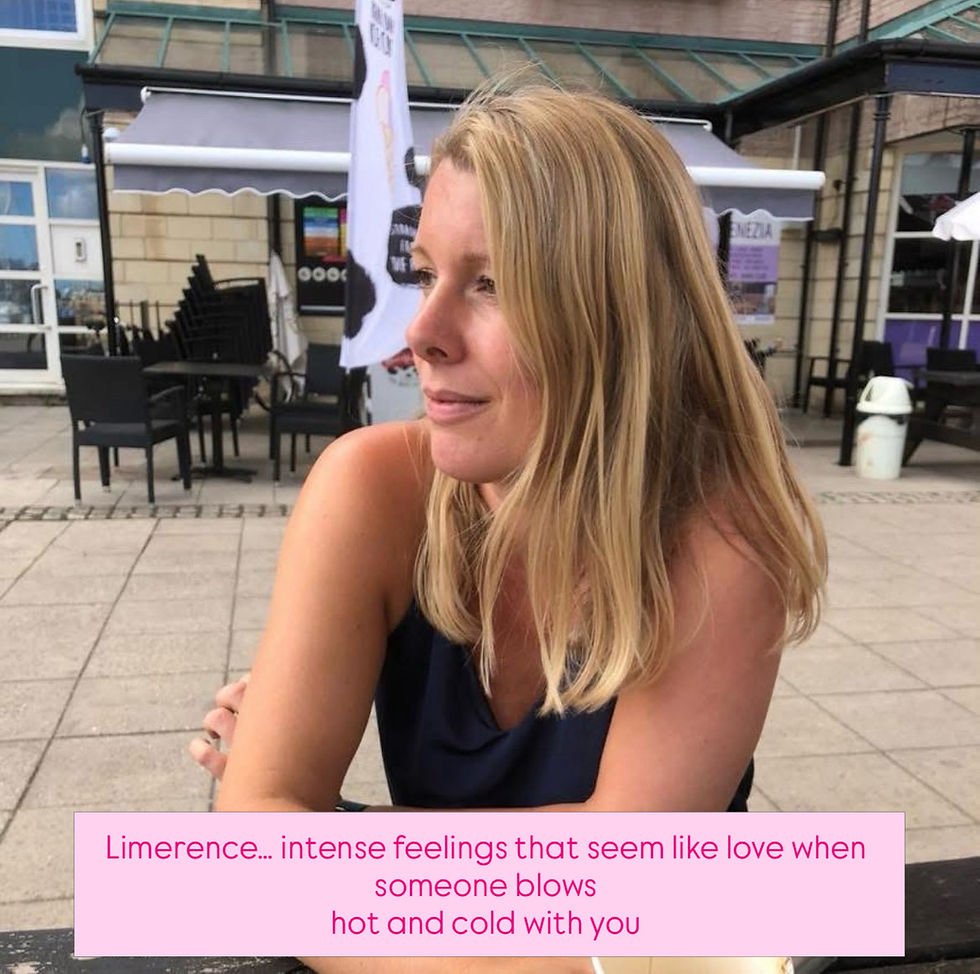
Limerence: intense feelings that seem like love until we learn to trust our gut
- pippa

- 7 minutes ago
- 4 min read

Have you ever felt completely consumed by thoughts of someone? Checking your phone constantly, analysing every social media post and feeling a deep emotional high when they give you attention… followed by an equally intense crash when they don’t?
This experience is often called limerence. And while it can feel like love, it’s usually something very different—especially when it shows up in avoidant or narcissistic relationship dynamics.
What is Limerence?
Limerence is an intense emotional state characterised by obsession, longing and a deep need for reciprocation. It can look like:
Checking your phone much more often than you'd like to admit
Constantly thinking about that person
Idealising them while overlooking red flags
A strong emotional dependency on their attention or approval
Feeling swings of intense happiness followed by anxiety and despair when contact is inconsistent
Feelings of shame that you're not enough for them
In healthy love, there is steadiness, reciprocal care and emotional safety. Limerence, on the other hand, tends to feel like a rollercoaster—driven by uncertainty and emotional highs and lows.
Why limerence thrives in toxic or avoidant dynamics
Limerence often intensifies in relationships where there is inconsistency, emotional unavailability or manipulation. This is why it frequently shows up in dynamics involving narcissistic traits.
When someone alternates between warmth and withdrawal - that 'hot and cold' behaviour - it can create a powerful emotional hook. The brain begins to associate the relief of receiving attention with a kind of reward, making the connection feel addictive.
This pattern can look like:
Being deeply drawn to someone who is hard to reach emotionally
Feeling you need to earn their love or approval
Interpreting small moments of kindness as proof of deep connection
Staying invested despite feeling anxious, confused or emotionally drained
Rather than feeling secure, you may feel activated - constantly trying to regain closeness.
People pleasing and limerence
For many people, limerence isn’t random—it connects to earlier relational patterns.
If you learned as a child that love was conditional, unpredictable or something you had to work for, you may have developed people-pleasing as a way to stay safe and connected.
This can show up as:
Prioritising others’ needs over your own
Avoiding conflict or rejection at all costs
Seeking validation through being 'good', helpful or accommodating
Feeling responsible for other people’s emotions
In a limerent dynamic, people-pleasing can intensify. You may find yourself trying harder and harder to be 'enough' for the other person - hoping that if you just get it right, they will finally choose you fully.
Abandonment wounds and inner child healing
At a deeper level, limerence often connects to unresolved abandonment wounds.
If, as a child, your emotional needs weren’t consistently met - whether through absence, unpredictability or emotional neglect - you may carry a deep fear of being left, rejected or not chosen.
Your inner child may still be holding beliefs like:
“I’m not lovable unless I prove it”
“People leave when I need them”
“I have to hold on tightly to keep connection”
When you meet someone who feels emotionally significant, but inconsistent, it can activate these old wounds. The intensity of limerence is often less about the present person, and more about the past longing to feel securely loved.
In this way, the relationship can become a stage where old patterns are replayed, in the hope of a different ending.
But it feels so real!
One of the most confusing aspects of limerence is how real it feels.
The emotional highs can feel like deep connection. The longing can feel like love. The pull toward the person can feel undeniable.
But often, what’s being activated is:
The nervous system responding to unpredictability
A trauma bond forming through intermittent reinforcement
A younger part of you seeking safety, validation, and belonging
This doesn’t make your feelings wrong, but it does mean they deserve to be understood with compassion, rather than acted on automatically.
Moving towards healing
Healing from limerence isn’t about being stronger or forcing yourself to get over someone. It’s about the journey of self-connection and learning how to trust your gut.
This might involve:
Exploring your attachment patterns
Noticing where you abandon your own needs to maintain connection
Building awareness of emotional triggers and patterns
Developing self-compassion for the parts of you that long to be loved
Reconnecting with your inner child and their unmet needs
Over time, as you begin to offer yourself the safety and validation you may not have received consistently in the past, the intensity of limerence often begins to soften.
Going forwards...
If you recognise yourself in this, you are not 'too much' or 'too needy.
Limerence is often a sign of a nervous system that learned to survive in uncertainty, and a heart that deeply longs for connection.
With awareness, support, and compassion, it’s possible to move from anxious longing toward relationships that feel steady, mutual, and safe.
If this resonates with you, therapy can be a space to explore these patterns safely and begin to build a more secure, compassionate relationship with yourself and others.


Comments